traction-engines.farmyard.im
Traction engines, ploughing engines — and tractors?
Official museum wording names traction engines and ploughing engines as separate things, and it keeps steam ploughing equipment distinct from a tractor. The desk below stays with those official sentences.
Open a topic
Two official engine names
The Museum of English Rural Life’s page for the John Fowler & Co. (Leeds) Ltd. Archive includes a heading “Fowler Ploughing Engines,” and then a drawings list titled: “Fowler Standard Drawings List (includes Traction engines, ploughing engines, ploughing engines, Fowler classes A, A1, A2, A3, A5, A7, A8, A9, AA).” [source]
That official list names traction engines and ploughing engines as separate items. The heading repeats the words “ploughing engines” twice, and the repetition is left as it appears on the official page. This site does not treat a traction engine as the same official class as a ploughing engine, and it does not treat either as a tractor.
The Steam Plough Works
The same official MERL archive page says: “In 1860 Kitsons, now restyled as Kitson & Hewitson, became sole suppliers and Fowler simultaneously began construction of his own works, the Steam Plough Works alongside Leathley Road, Leeds on land adjacent to and purchased from Kitsons.” It later says that “Next year with the Steam Plough Works completed all production was moved there from Kitsons.” [source]
The official name of those works is the Steam Plough Works. That is museum archive wording about a firm and a place in Leeds, not a count of engines in a field today, and not a photograph caption.
1850, with care
The official MERL page is careful about the firm’s starting date. It says: “The early business history of John Fowler is somewhat confused, especially as the later publications of John Fowler & Co. (Leeds) Ltd., claim that the firm’s origins date to 1850. Indeed John Fowler did begin in business in 1850, but in Bristol not in Leeds, by forming a partnership with a fellow Quaker, Albert Fry, as agricultural implement manufacturers and traders.” After that partnership ended in 1856, the same official page says, Fowler moved to 28 Cornhill, London “to concentrate on his consuming interest in steam cultivation machinery.” [source]
This site does not flatten that official wording into a single “founded in Leeds in 1850” sentence.
Not a tractor
Official MERL wording on a tractor plough, object 79/68, says: “The mass-produced Fordson tractor was more compact and efficient than steam ploughing equipment, and faster than horse ploughing.” [source]
That official sentence keeps steam ploughing equipment, a tractor, and horse ploughing as different kinds of work. Sister site ploughs.farmyard.im quotes the same label in full, and keeps a horse plough, a tractor plough and steam ploughing equipment distinct. A traction engine, and a ploughing engine, are not treated here as tractors.
A rally is not a working day
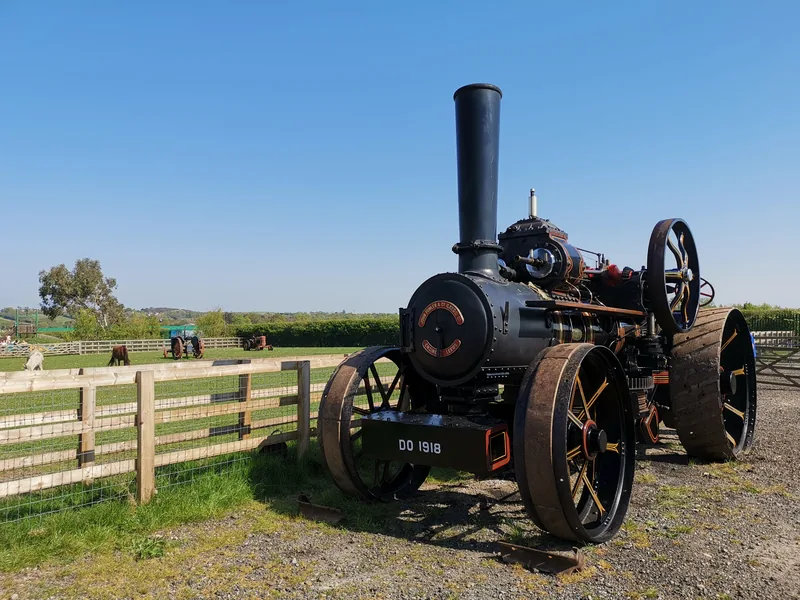
Photographs on this site show a 1917 Fowler ploughing engine at Barleylands Farm Park, a Fowler engine at Shifnal, a ploughing engine at the 2016 World Ploughing Championships, and a Burrell traction engine photographed in New Zealand. A farm park, a championship display, and a photograph taken in New Zealand are not presented here as typical English commercial days, and they are not museum object records.
Three questions
1. The official MERL Fowler drawings list names which of these as separate items?
2. According to the official MERL Fowler archive page, where did John Fowler begin in business in 1850?
3. The official MERL label on a tractor plough says the mass-produced Fordson tractor was more compact and efficient than:
Enjoyed the steam?
No pop-ups. No intrusive advertising. Just interesting stuff. A little support helps the next farmyard site get built.